
Published 2026-09-05 · Last updated 2026-09-05
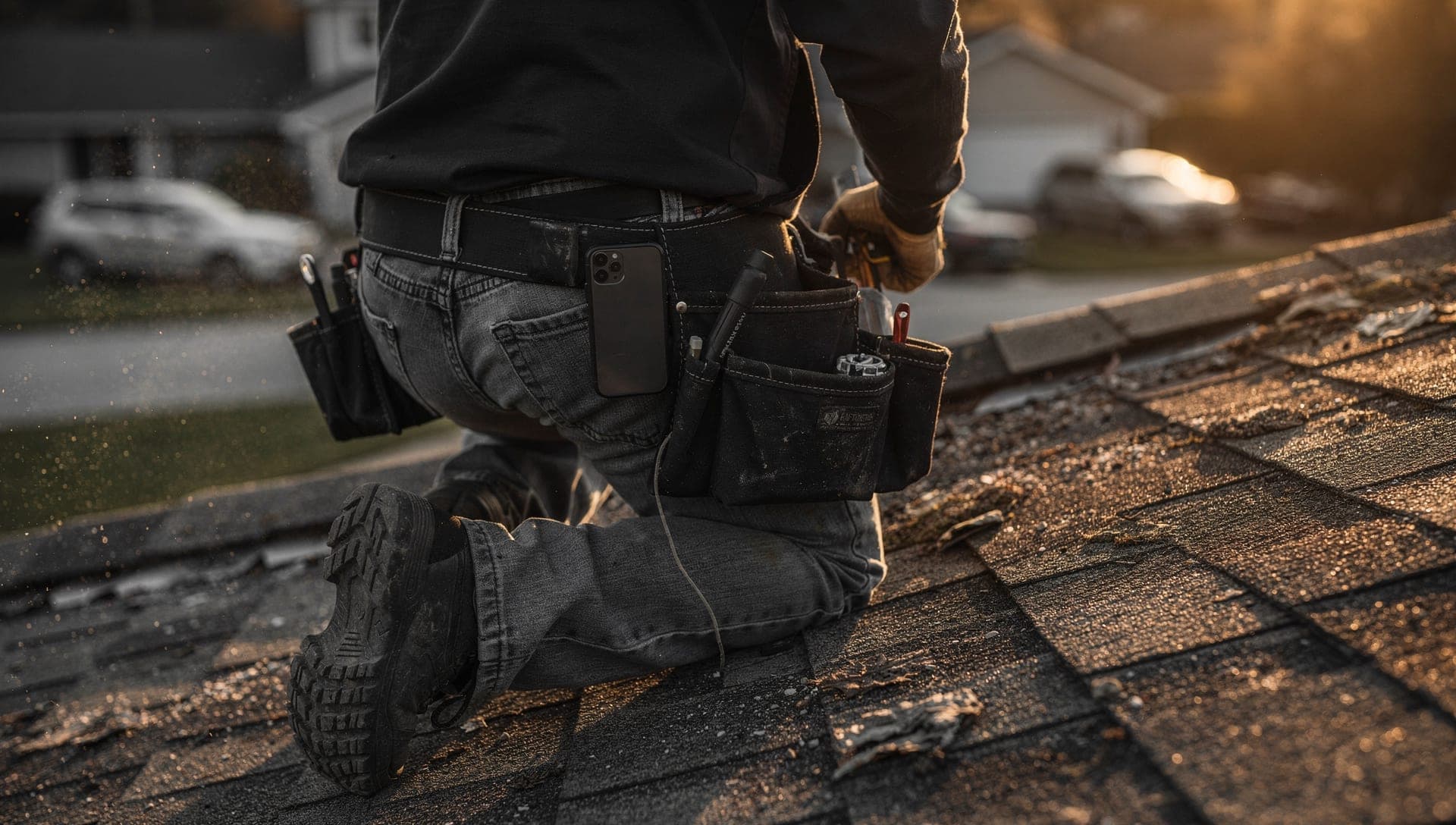
When a new customer calls while you are on a roof, one of three things happens: someone answers, the call rolls to voicemail, or it rings out. Invoca's 2026 home services benchmarks, built from more than 70 million calls, found the industry answers 52 percent of inbound calls, so roughly half of dials go unanswered. What happens in the next thirty seconds decides whether that customer books with you or with the next number on the list. This article lays out a coverage plan for jobsite hours, nights, and weekends that does not involve a call center.
What are the odds a home services call gets answered?
Invoca reported in May 2024 that 27 percent of calls to home services businesses were not answered. Its July 2026 benchmark report, drawn from more than 70 million calls and 600 million minutes across 10 industries, found the answer rate at 52 percent of all inbound calls, 65 percent of calls lasting more than 15 seconds, and 73 percent of calls over 30 seconds.
That spread is the useful part. The longer a caller stays on the line, the more likely they reach someone, which means a large share of the losses happen in the first 15 seconds. The caller hears four rings and hangs up. Speed of pickup is the first thing to fix, before anything about scripts or scheduling.
What is riding on the call?
A widely quoted Invoca figure, cited by Housecall Pro in a resource updated in October 2025, puts average revenue lost per missed home services call at $1,200. That is an industry average, and your number depends on your ticket size, but the direction is clear. Invoca's 2026 benchmarks also found 38 percent of calls from digital marketing are real leads and 45 percent of those leads convert on the call itself. The call is not a step toward the sale. For nearly half of qualified callers, it is the sale.
The same report found 55 percent of home services businesses never ask the caller to book. Answering the phone on a roof is hard. Answering it and then not asking for the appointment is a second miss on the same call.
Does after-hours coverage matter to the caller, or just to you?
It matters to them, and they read it as a signal. CallRail's September 2025 survey of 1,000 US consumers found 52 percent see a business offering an after-hours AI assistant as a sign of superior service. In the same survey, 50 percent said they would let AI book an appointment for them, 91 percent among Gen Z, 66 percent would use AI to check hours or a location, and only 13 percent reject AI for every task.
The phone is still the channel. Housecall Pro cites BrightLocal data that 60 percent of consumers still choose to contact local businesses by phone. And GetApp's March 2021 research with 217 screened US respondents found 17 percent of consumers are frustrated at having to wait until a provider opens to schedule at all. A furnace that quits at 9 p.m. does not wait for 8 a.m., and neither does the homeowner.
A coverage plan by time of day
The goal is that every call is picked up within a few rings, every hour, without anyone being tied to a desk. Here is the plan most trades businesses can run.
| Window | What usually happens | What should happen |
|---|---|---|
| Jobsite hours, weekdays | Owner's phone rings in a pocket, then voicemail | Ring group to the office or an AI receptionist picks up in seconds, books, and texts the owner a summary |
| Evenings | Unanswered; caller phones the next company | AI receptionist answers, sorts emergency from routine, books the next open morning slot |
| Weekends and holidays | Rings out | Same coverage, with an on-call transfer rule for true emergencies |
| Overnight | Rings out | AI receptionist takes the booking; emergencies transfer to the on-call phone |
The AI receptionist is doing the same job at every hour, which is the point. One system, one script, one set of rules, and you are not paying a call center to read a screen.
What the AI has to do on a night call
- Say it is an AI in the first sentence, so the caller can judge it on the help it gives
- Ask what is wrong, one question at a time, and repeat the address back
- Decide whether it is an emergency using the words you approved, and read your approved instruction if it is
- Book the next open slot on your calendar, or transfer to the on-call phone if the rule says so
- Text you the summary and the transcript before the caller has put the phone down
Invoca modeled a five-point improvement in each of answer rate, lead rate, and on-call conversion and found it produced about 38 percent more conversions from the same call volume. Coverage on nights and weekends attacks the first of those three directly, and asking for the booking on every call attacks the third.
How to test it before you rely on it
Call your own number from a jobsite at 4 p.m. on a Tuesday, from home at 9 p.m., and on a Saturday morning. Time how long it takes to be picked up. Ask for a booking. Say the word 'emergency' and see what happens. If any of those three calls ends in voicemail, that is where the leak is, and it is where the next customer is going to leave.
Common questions
Do I need a human answering after hours for emergencies?
You need a human reachable for emergencies. The AI receptionist should identify the emergency from approved trigger words, read your safety instruction, and transfer to the on-call phone. Routine calls should never wake anyone.
Will customers calling at night accept an AI?
CallRail found 52 percent of consumers see an after-hours AI assistant as a sign of superior service and only 13 percent reject AI for every task. Most callers at 9 p.m. want a confirmed time, and an AI that gives them one beats a voicemail that does not.
What if my calendar is full for the week?
The AI should still book the first open slot and tell the caller the date, then flag the call so you can decide whether to move something. A far date with a confirmation beats no date at all.