
Published 2026-11-14 · Last updated 2026-11-14
If you want Google's AI to name you, yes. A template website gives Google's AI less to read about your business than a site coded from your own business facts, and less to read means fewer chances to be the name it gives. A custom-coded website states every service, every town and every answer in plain words and in structured data, and keeps both matching your Business Profile, because the same data writes the page and the structured data. Optimus Business Solutions, a web design and AI systems company in Salem, New Hampshire, explains how homeowners now find a tradesman through Google's AI, what that AI reads about your business, where template builders fall short, and what to check on your own site.
How do homeowners find a tradesman with Google's AI search?
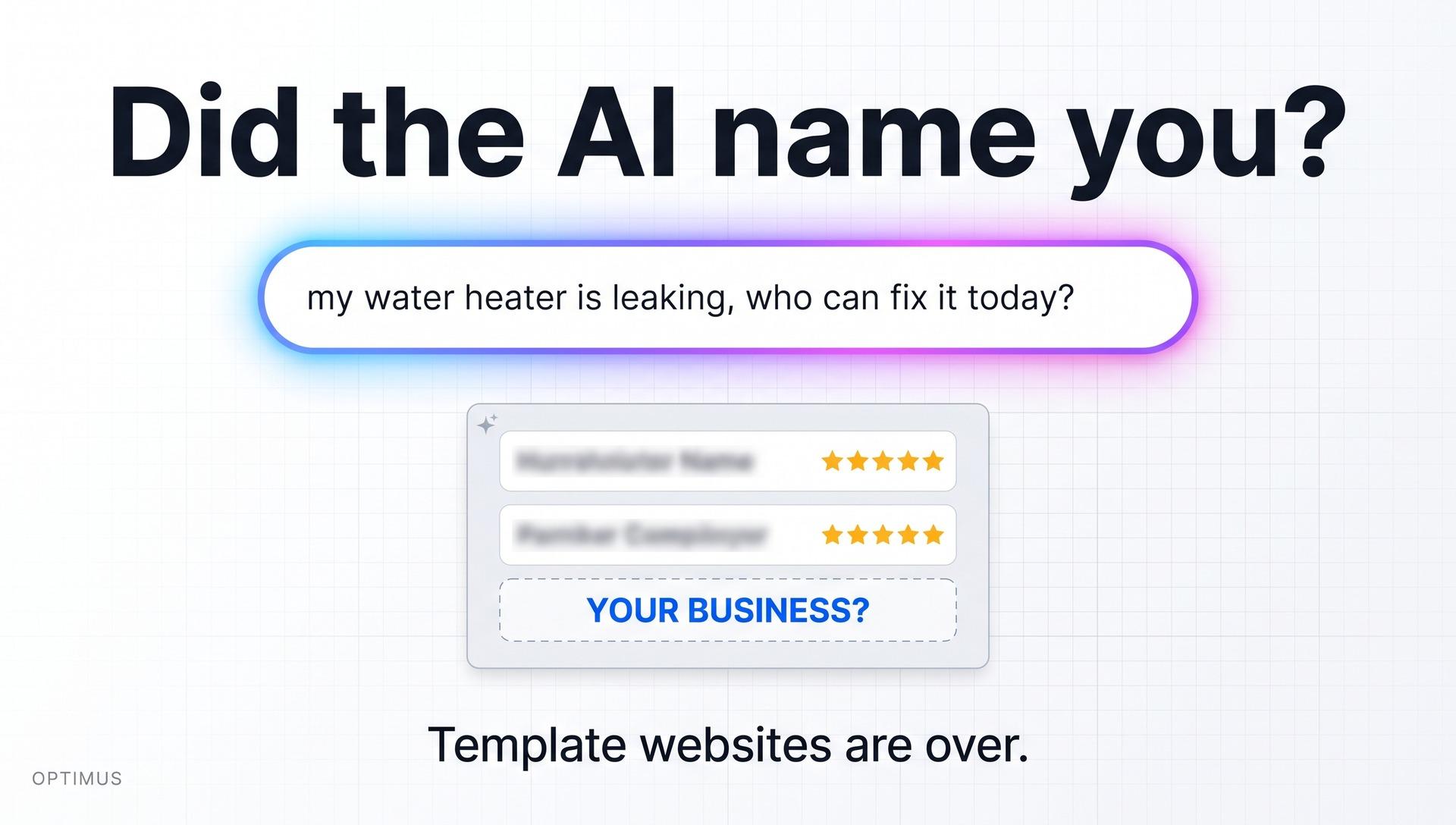
Picture a homeowner who finds water across the basement floor. The water heater is leaking. She does not call a relative for a name and she does not scroll through ten blue links. She opens Google, asks who can fix a leaking water heater right away, and Google's AI answers with a short summary and a few business names. She calls one of them. For a plumber, that one call can be a few thousand dollars of work. The question for every trade owner is simple: did the AI name you, and what did your website give it to work with?

This is not a corner of Google anymore. Google's own help page tells people to enter a question in the Search bar and tap AI Mode, and Search Engine Roundtable reported that the AI Mode button reached the main google.com search box in July 2025. At its I/O conference in May 2026, Google said AI Mode had passed one billion monthly users, and it began rolling out what it called the biggest upgrade to its Search box in over 25 years, in every country and language where AI Mode is available. Google says that is over 200 countries and territories.
The answer can now go one step further. According to Search Engine Journal, Google added booking and quote links for home services inside AI Mode in the United States in November 2026, through partners including Angi, Thumbtack, Jobber and Housecall Pro. Google has not said how AI Mode chooses which businesses to show. For a trade owner, the practical meaning is plain: the homeowner can pick a business, or be handed to a lead marketplace, before ever visiting your website.
Are fewer people clicking through to business websites?
Google and independent researchers describe this differently, and it is worth hearing both. Google's position, from its head of Search in August 2025, is that total organic clicks from Google to websites have been relatively stable year over year, and that clicks from AI results are higher quality. Independent studies measure the click rate per search, and they find fewer people scrolling down to the list.
| Who | What they measured | What they found |
|---|---|---|
| Google, August 2025 | Total organic clicks from Search to websites | Relatively stable year over year; clicks from AI results are higher quality |
| Pew Research Center, 2025 | 68,879 real searches by 900 U.S. adults | With an AI summary, people clicked a regular result in 8 percent of visits; without one, 15 percent |
| Seer Interactive, 2025 | Organic click-through on searches showing an AI Overview | Fell 61 percent between mid-2024 and September 2025 |
| Semrush, 2025 | About 69 million AI Mode sessions, U.S. desktop | 6 to 8 percent led to a visit to an outside website |
Both can be true at once. People search more than ever, and fewer of them scroll past the answer at the top. That answer is doing more of the picking, so what it can read and trust about your business matters more than it did.
What does Google's AI read about your business?
Google's AI can only name a business it can read. It reads the words on your pages, the structured data behind them and your Business Profile, and when all three say the same thing, nothing is left to guess. Google's Search Central blog says structured data is useful for sharing information about your content in a machine-readable way that its systems consider. Microsoft's Bing has said schema markup helps its AI models understand content, according to Search Engine Roundtable.
Structured data, often called schema, is a small block of code that labels your business facts in a shared vocabulary from schema.org, a project Google, Microsoft, Yahoo and Yandex founded. Schema.org says that as of 2024, over 45 million web domains mark up their pages with it. For a trade business, the facts worth stating clearly, in words on the page and in structured data, are these:
- Every service you want to be called for, each on its own page
- Every town and area you serve
- Your hours, including emergency or after-hours service
- Your reviews and how customers rate the work
- How to book or request an estimate
- Answers to the questions homeowners ask before they call
Read our plain-words guide to schema markup
None of this is a magic tag. Structured data is how a site states its facts so clearly that nobody, a person or a machine, has to guess. The facts still have to be true, specific and the same everywhere: on your site, in your markup and on your Business Profile.
Do template website builders limit schema?
Some do, and their own help pages say so. Wix accepts custom structured data in JSON-LD only, each markup must be under 7,000 characters, a page can hold up to five, and markup can be added only to static pages, not dynamic ones. Squarespace offers code injection on its Core, Plus and Advanced plans and some legacy plans. GoDaddy's Websites + Marketing builder adds custom code as an HTML section placed on the page. Duda builds local business structured data automatically from the site's business fields, and its developer documentation says only the primary location is used.
WordPress is different, and it deserves a fair word. WordPress can carry any structured data a developer writes, through the wp_head hook that prints code into every page's head, and the Yoast SEO plugin, active on more than 10 million sites, documents a full schema API. So WordPress itself is not the problem: a WordPress site a developer codes around your business is custom work. The problem is the template. The theme says what it says about every business, a generic plugin knows the post, not your business, and nobody keeps your facts complete and matching your page every time you add a service or a town.
How does a custom-coded website keep the page and the schema in step?
On the sites we build at Optimus, the questions on your page and the schema Google reads come from the same file, so they never drift apart. Add a new town or a new service, and the page and its schema change together in one update. Every service, every town and every answer is told the same way to the homeowner and to Google's AI.
That is the difference custom code makes. A template gives every business the same structure. A custom-coded site is built around yours, so Google's AI gets more of your business to read.
Why do trade businesses gain the most from being named?
Because one job is worth a lot. According to HomeGuide's cost data, which comes from research and project costs its members report, a new roof averages about 10,800 dollars nationally, an AC replacement runs about 5,000 to 8,300 dollars, a tank water heater with installation runs about 600 to 3,100 dollars, and a breaker box replacement averages about 1,475 dollars. Those are what homeowners pay, not your profit, and a lead is not a job. Still, the math is different from most businesses: a trade owner does not need a hundred leads, only to be named when the right homeowner asks.
Every job that comes in that way is yours, not a shared lead rented from a marketplace. Our founder, Anthony Rosa, calls it an automated organic lead engine: a website and a Business Profile that keep telling Google exactly who you are, what you do and where, while you are out on a job. The website and the profile work together; neither wins alone.
What should you check on your own website?
- Ask Google's AI Mode the question your customer would ask, in your town, and read which businesses it names
- Make sure each service you want to be called for has its own page in plain words
- Name every town you serve on the site, not only in a footer
- Check that your hours, phone number and booking steps match your Google Business Profile exactly
- Run your pages through Google's Rich Results Test and see which structured data it finds
- Confirm the structured data says only what the page shows, and that someone updates both together
If the AI names your competitors and not you, or your site and your profile disagree, that is the first thing to fix.
Common questions
Does a custom-coded website help with Google's AI search?
Yes. A custom-coded site states every service, town, hour and answer in plain words and in structured data, and keeps both matching your Business Profile. That gives Google's AI more of your business to read than a template that says the same thing about every business. Google's Search Central blog calls structured data useful for sharing your information with its systems.
Is WordPress bad for AI search?
No. WordPress can carry any structured data a developer writes, and plugins such as Yoast add schema to millions of sites. The question is whether someone keeps that structured data complete and matching the page as the business changes.
Does Wix support schema markup?
Yes, with limits stated in Wix's own help center: custom markup must be JSON-LD, under 7,000 characters, up to five per page, and only on static pages.
What is Google AI Mode?
AI Mode is Google's AI search experience, opened from the AI Mode button in the Google search box or at google.com/ai. Google said in May 2026 that it had passed one billion monthly users.
Can AI Mode send my customers to Angi or Thumbtack?
According to Search Engine Journal, Google added booking and quote links for home services in AI Mode in the United States through partners including Angi, Thumbtack, Jobber and Housecall Pro. Google has not said how AI Mode chooses which businesses to show.
Submit an inquiry about what Google's AI can read about your business