
Published 2026-11-08 · Last updated 2026-11-08
If you run Google Local Services Ads, it makes sense to have every call answered, and a voice AI receptionist is one practical way to cover the hours you cannot pick up yourself. According to Google's Local Services help page, "How leads work", a call can become a charged lead whether you answer it or miss it: a missed call during business hours counts when the caller stays on the line for more than 20 seconds, and an answered call is evaluated based on your conversation with the customer. Either way, the call is something you may pay for, so the call worth having is the one that turns into a conversation. Optimus Business Solutions, a web design and custom AI agent company in Salem, New Hampshire, explains how the rule works, why an unanswered call is the only truly wasted one, and what to look for if you want an AI receptionist to answer for you.
Can Google charge for a Local Services Ads call I answer?
Yes, an answered call can be a charged lead. Google's help page says that when you pick up, the call lead is evaluated as an answered call based on your conversation with the customer. That has always been the core of Local Services Ads: you pay for leads, and a real conversation with a customer looking for your kind of work is the lead.
What changed is the other side. Under Google's rules for Local Services Ads, a call you miss during your business hours can also be charged when the caller stays on the line for more than 20 seconds. A call that goes to voicemail or an automated greeting during business hours is treated as a connected call and charged the same way, whether or not the caller leaves a message. If the caller presses a key in a phone menu, Google says the 20-second timer resets, so a menu only buys a little time.
Put the two together and the choice is simple. A call through your ads can be charged whether it is answered or missed. The only difference is whether you got the conversation.
Why is an unanswered call the only wasted one?
Think about what each kind of call gives you. An answered call gives you the customer's name, the problem, the address and a chance to win the job. A missed call that was charged gives you a number in your call log and a customer who may already be dialing the next business on the list. You may pay for both. Only one of them can turn into work.
That is why the useful question is no longer how to avoid the charge. Google's own settings help with that: missed calls are only charged during your active ad schedule and within the hours on your Google Business Profile, and once a lead is charged, follow-up calls or messages with that customer are not charged again as long as there is interaction within 15 days. Those settings matter, and they are worth getting right. But the bigger lever is making sure the calls you run ads for are answered by someone, or something, that can take the details.
Why do so many calls go unanswered in the first place?
For most local service businesses, it is not a lack of effort. It is the work itself. The person who answers the phone is usually the same person doing the job, and the busiest hours for calls are often the busiest hours on the job site.
- A roofer is on a roof, and the phone is in a jacket on the ladder.
- A plumber is under a sink with both hands on a fitting.
- An electrician is at a panel and is not going to stop mid-task to take a call.
- A salon owner is in the middle of a color appointment with a client in the chair.
- The office person is at lunch, on another line or out for the day.
None of those are mistakes. They are simply moments when nobody can pick up. The difference with Local Services Ads is that those moments can now carry a charge, and the caller still has a list of other businesses one tap away.
How does a voice AI receptionist handle a Local Services Ads call?
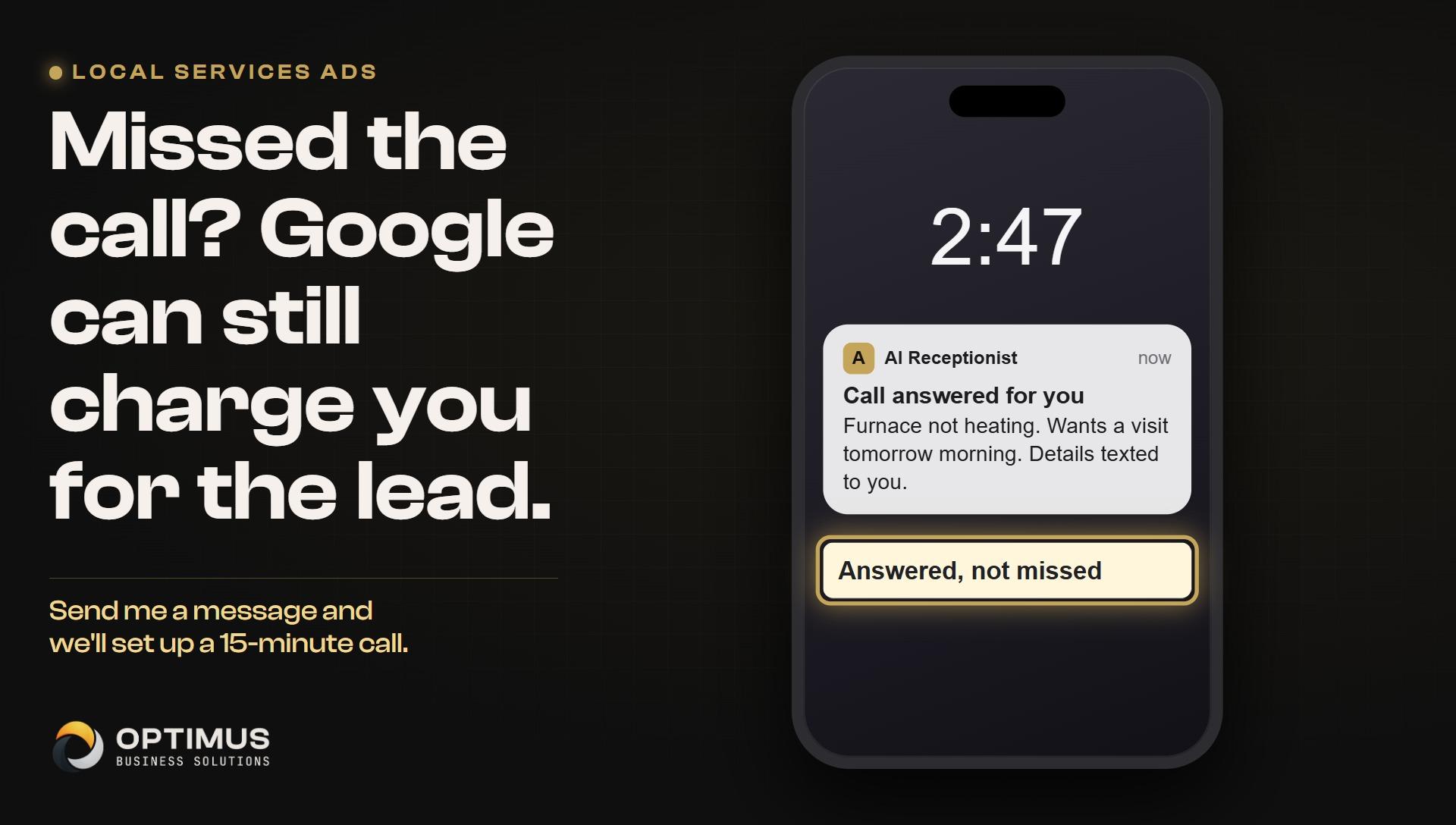
A voice AI receptionist is a custom AI agent that answers your business line when you cannot. At Optimus Business Solutions, we automate your workflow with custom AI agents, and the receptionist is one of them: it answers every call, day or night, takes the details and texts them to you. The caller talks to something that answers in your business's name, explains what they need and leaves with the sense that someone is on it. You finish the job, look at your phone, and the details are already waiting.
For a Local Services Ads advertiser, that changes what a charged call is worth. Instead of a missed call and an empty voicemail box, you get the conversation the call was supposed to be: who called, what the job is, where it is and how urgent it feels. Your callback starts with the job already understood, which is a much better place to start than "Hi, I saw I missed your call."
It also fits the way Google treats callbacks. Google's help page says a follow-up call where you speak with the customer is evaluated using the rules for an answered call, and that calls on a charged lead within 15 days are not charged again. When the receptionist has already captured the details, that callback is quick and focused, and it happens inside the window.
What should I check before letting an AI answer my business line?
An AI receptionist is a tool, and like any tool it should be set up for the way your business actually works. Before you put one on your line, check these points with whoever builds it.
- It answers in your business's name and sounds like your business, not a generic script.
- It knows your services, your service area and your hours, so it does not promise work you do not do.
- It captures the details you need to quote or schedule: name, number, address, the problem and how soon.
- It texts you those details right away, in a format you can read in a few seconds on a job site.
- It handles the calls that need a person, such as an emergency, by getting them to you fast.
- It follows the rules where you work on recording and disclosure, which differ from state to state.
The goal is not to replace you on the phone. It is to make sure that when you cannot pick up, the caller still reaches your business and you still get the conversation.
How do I know if answering every call is working?
You do not need a complicated report. A few simple comparisons, before and after, will tell you most of what you need to know.
| What to look at | What it tells you |
|---|---|
| Missed calls from your ads, by hour | Which hours were leaving charged calls on the table |
| Calls answered with details captured | How many calls turned into a usable lead |
| Time from call to your callback | Whether the customer heard back while still deciding |
| Jobs booked from Local Services Ads | Whether the conversations are turning into work |
| Leads you disputed as poor quality | Whether spam or wrong numbers are getting through |
Google also lets advertisers report a poor quality lead in that lead's feedback survey, and its help page says it may credit leads reported that way. Keeping notes on each call makes those reports easier and keeps your numbers honest.
We have built systems for 40+ businesses, and the idea behind every one is the same: big-company technology, built for small businesses. A large company can staff a phone team around the clock. A local business can get the same coverage from a system built around the way it already works, so every call through its ads becomes a conversation.
Common questions
Does Google charge for Local Services Ads calls I answer?
An answered call can be a charged lead. Google's Local Services help page says an answered call is evaluated based on your conversation with the customer.
Does Google charge for a missed Local Services Ads call?
It can. Google's help page says a missed call during your business hours is charged when the caller stays on the line for more than 20 seconds, and a call that reaches voicemail or an automated greeting in business hours is treated as a connected call.
What does a voice AI receptionist do with the call?
The voice AI receptionist we build answers every call, day or night, takes the details and texts them to you, so you can call back with the job already understood.
Will an AI receptionist stop Google from charging for the call?
No. A call answered by a receptionist is still a call, and Google evaluates answered calls based on the conversation. The point is that the call becomes a conversation with the details captured, instead of a missed call.
Is a callback charged again?
Not when it follows a charged lead with the same customer within 15 days. Google says follow-up calls or messages are not charged again as long as there is interaction within that window.
Source: Google Local Services Help, "How leads work" (support.google.com/localservices/answer/7195435).