
Published 2026-10-27 · Last updated 2026-10-27
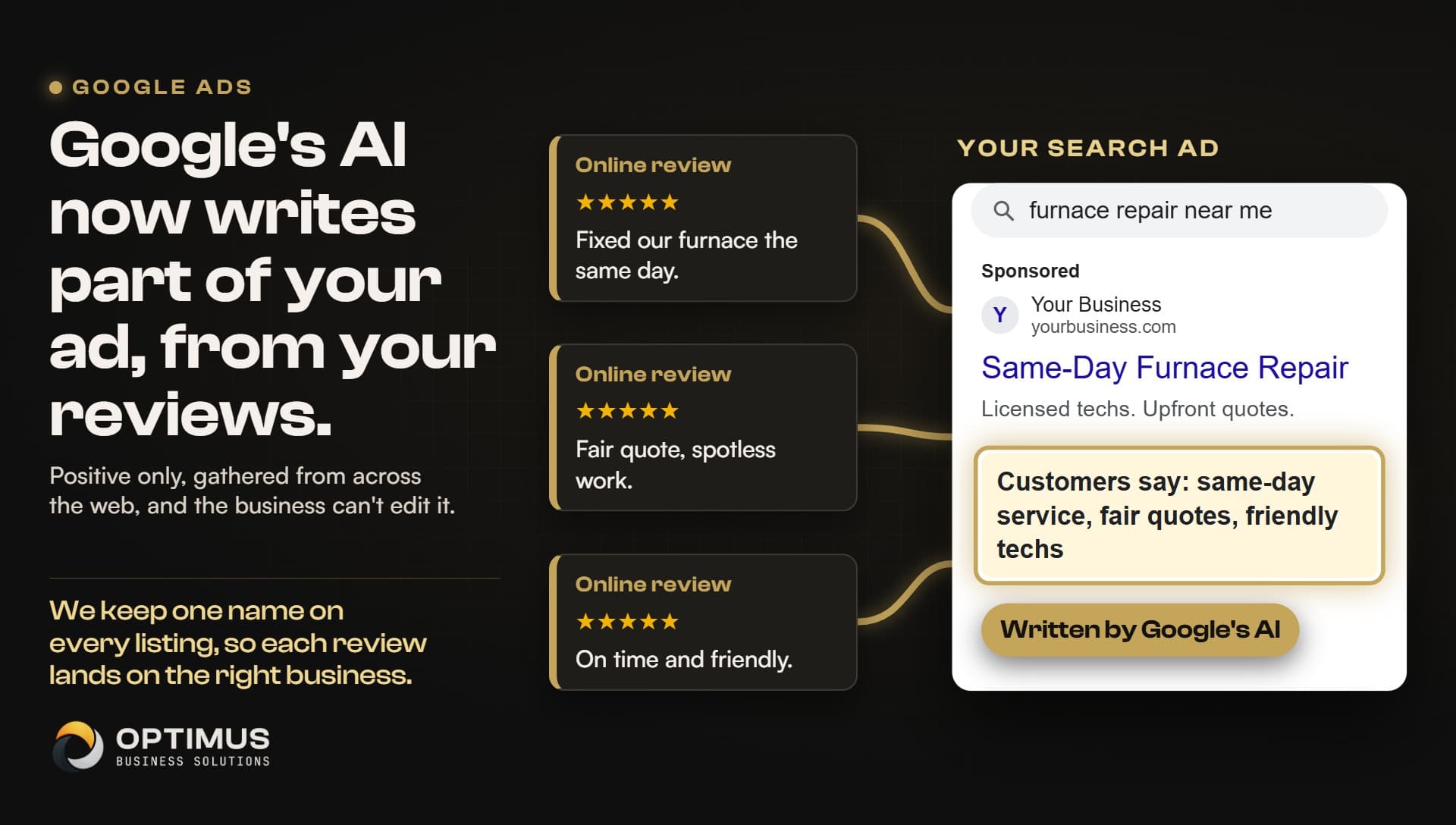
Google can now write part of a business's Search ad from that business's online reviews. According to Google's own Google Ads help page, About Review summaries, these are AI-powered summaries of online reviews that appear directly as part of Search ads; Google's AI gathers the reviews from across the web, the summaries are positive only, and advertisers cannot edit the text. Search Engine Roundtable's Barry Schwartz reported on the help document on October 26, 2026. Optimus Business Solutions, a web development company in Salem, New Hampshire, helps local businesses with AI search optimization, and this article explains what the feature does, what an owner can and cannot control, and the small habit that helps your reviews say the right things about you.
What are review summaries in Google Search ads?
A review summary is a short line of text, written by Google's AI, that sits inside a Search ad and describes what customers say about the business. Google's help page describes them as summaries that represent customer experiences and key insights about your business. The idea is simple: someone searching for a service sees an ad, and inside that ad is a quick read on what earlier customers thought.

Two details stand out. First, the reviews do not have to come from Google. Google's help page says its AI automatically aggregates online reviews from across the web to generate the summaries, and it does not list which sites. Second, the summary is not something you write. Google says advertisers cannot directly edit or customize the generated text.
Google also says it only shows review summaries when it predicts they will improve ad performance. So the summary will not appear on every ad, every time. Google decides when it helps.
Where and when do review summaries appear?
According to the help page, review summaries apply to Search campaigns, can appear in all ad positions on Google.com, and are listed for English in the United States, the United Kingdom, Australia and India. Google lists all advertiser categories as eligible except sensitive ones, such as pharmaceuticals. For a home service business, a shop or a professional practice in New Hampshire or Massachusetts that runs Search ads, that means the feature can apply to you.
| Question | What Google's help page says |
|---|---|
| Where do the reviews come from? | Google's AI gathers online reviews from across the web. |
| Is the summary positive or mixed? | Positive only. |
| When does it show? | Only when Google predicts it will improve ad performance. |
| Can the business edit it? | No. Advertisers cannot edit or customize the text. |
| Which ads? | Search campaigns, all positions on Google.com. |
| Which markets? | English in the US, UK, Australia and India. |
Why does this matter if you never run ads?
Plenty of small businesses never run a Google ad, and that is fine. The feature still points at something worth noticing. Google is reading reviews from many sites, pulling out what customers liked, and putting it in front of people who are deciding who to call. The reviews you collect are no longer just a star count on one listing. Their words are raw material.
The same is true, in a looser way, of the other places people look a business up. Map apps, review sites and AI assistants all read what they can find about a business, and reviews are part of that picture. No one outside those companies knows exactly how each system weighs the words in a review, and we do not claim to. But a review that clearly says what you did, and where, is easier for any reader, human or machine, to understand than two words of praise.
Think about it from the customer's side. A homeowner comparing three plumbers sees a short summary under each name. One says customers praise friendly service. Another says customers mention fast water heater replacements in Salem and Windham. The second one answers the question the homeowner actually has. The difference comes from what customers wrote.
What can an owner actually control?
You cannot edit the summary, choose when it shows, or pick which review sites Google reads. What you can do is shape the raw material, honestly, by how you ask for reviews and how you look after the places they are posted.
- Ask at the right moment: right after a job goes well, while the customer is still pleased and the details are fresh.
- Ask for specifics, not stars: invite the customer to mention what you did and the town you did it in. Never script their words or offer anything in return for a review; both break platform rules and erode trust.
- Make it easy: send one short message with a direct link to the review page you most want to grow.
- Spread out over time: a steady trickle of recent reviews reads more naturally than a burst followed by silence.
- Reply to reviews: a short, human reply to good and bad reviews shows the next customer how you treat people.
- Keep your name the same everywhere: the business name on your Google profile, your website, Yelp, Facebook and other listings should match exactly, so reviews from every site are clearly about the same business.
How should you ask a customer for a better review?
Most owners ask for a review with a line like "If you were happy, would you leave us a review?" It works, but it invites a short answer. A better ask is just as short and gives the customer a nudge toward detail without telling them what to say.
Something like this works well in a text after the job: "Thanks again for having us out. If you have a minute, a quick review mentioning what we did for you would mean a lot, and it helps your neighbors find us." That is it. You are not asking for five stars or giving them words. You are asking them to describe the job, which is the most useful thing a review can do.
If you have staff in the field, give them the same simple ask so every customer hears it, and send the follow-up text from the business so it arrives with the right link. Then reply to the review when it comes in, by name where the customer used one, and thank them for the specific thing they mentioned.
How do reviews connect to AI search optimization?
AI search optimization is the work of making sure the facts about a business read the same, and read clearly, everywhere customers and AI systems look: Google, Apple Maps, Yelp, Bing and the professional platforms that matter for a trade. Reviews are one of those facts. When the name, the services and the towns on your website match your profiles, and your customers' reviews describe the same services in those same towns, every source tells one consistent story.
That consistency is the part an owner can build on purpose. Google decides what goes in a summary. You decide whether the facts it reads about you are accurate, current and the same from one site to the next.
What did Optimus do on its own listings first?
We use what we sell on ourselves before we offer it. We checked our own business name on Google Maps letter by letter and set one spelling of the name across our listings, so every profile says Optimus Business Solutions the same way and every review lands on the same business. We read our own Business Profile numbers every week alongside our website numbers, so a change in how people find us shows up in our notes rather than as a surprise.
That is how we approach AI search optimization for the 40+ businesses we have worked with: the website, the profiles and the listings tell one story, and the reviews customers write have a clear place to land. Big-company technology, built for small businesses.
Common questions
Can I turn off review summaries in my Google ads?
Google's help page does not describe a way to opt out. It says advertisers cannot edit or customize the generated text, and that Google shows the summaries only when it predicts they will improve ad performance.
Will a bad review show up in my ad?
According to Google's help page, review summaries are positive only. Negative reviews still exist on the sites where they were posted, so replying to them calmly is still worth doing.
Which review sites does Google read?
Google's help page says its AI gathers online reviews from across the web. It does not list specific sites, so keeping your listings accurate on the major platforms is the safe approach.
Can I tell customers what to write in a review?
No. Asking a customer to mention the job they hired you for is fine. Writing the review for them, or offering a reward for a review, breaks the rules of most review platforms.
Does a good review summary guarantee more calls?
No. No one controls which ads Google shows or what a summary says. Accurate listings and honest, specific reviews give your business a fair chance to be described well.
Sources
- Google Ads Help, About Review summaries: https://support.google.com/google-ads/answer/18760807
- Search Engine Roundtable, Google Ads AI-Generated Review Summaries Help Document: https://www.seroundtable.com/google-ads-ai-review-summaries-doc-42370.html
Submit an inquiry about your reviews and AI search optimization